
Practice 02
Every dataset findable, protected and ready for AI.
Data management and tiered storage for organisations whose data has outgrown a single system: research institutes, AI teams, media libraries and public bodies. Built on Spectra Logic and Arcitecta Mediaflux.
01The problem
More data than any one system should hold.
Primary storage is fast and expensive, so finished data piles up wherever there is room. It becomes hard to find, costly to keep and exposed to a single failure or attack.
Growth outpaces budget
Keeping everything on primary storage costs more every quarter.
Data nobody can find
Files without metadata are kept but never reused.
One copy is no copy
Ransomware and site failures need an off-line, verified copy.
AI needs it back, fast
Training and analysis need whole datasets staged on demand.
02Reference architecture
From source to GPU, by policy.
Mediaflux indexes every file and applies policies; Spectra Logic object storage and tape keep data at the lowest sensible cost; datasets are found by their metadata and staged back to performance storage when a job needs them.
Data sources
Instruments, sequencers, cameras, simulations, sensors and business applications.
NFS / SMB / S3Metadata and data management
Every file indexed with its metadata; policies decide copies, tier and retention.
Arcitecta MediafluxStorage tiers
Retrieval and staging
Find datasets by metadata; stage them back to the performance tier automatically.
Policy-driven recallAI and GPU workloads
Training, inference pipelines, analytics and HPC on complete datasets.
GPU clusters / HPCSimplified. Designs are sized to data volume, growth, access patterns and retention rules.
03Storage tiers
Each kind of data on the right medium.
Moving data between tiers is automatic and reversible. Users and applications see one namespace; the policy decides where each file lives.
| Tier | Medium | Typical data | Access | Cost per TB |
|---|---|---|---|---|
| Performance | NVMe flash | Active training sets, scratch, current projects | Immediate | Highest |
| Nearline | Disk | Recent projects, frequently reused data | Immediate | High |
| Object | Spectra BlackPearl, S3 | Completed datasets shared across teams and sites | Seconds | Moderate |
| Archive | Spectra tape libraries, LTO | Archives, compliance copies, the off-line copy | Minutes | Lowest |
04Use cases
Where it pays back first.
The architecture is the same; the policies, metadata and sizing change with the work.
AI and machine learning data
Keep every training set and model version; stage the ones in use onto GPU storage.
Scientific research and HPC
Instrument and simulation output catalogued by project, kept for re-analysis.
Life sciences and genomics
Sequencer data tiered after processing, with provenance kept in metadata.
Government and public records
Retention rules enforced by policy, with audit trails.
Video surveillance and evidence
Long retention at low cost, with chain-of-custody metadata.
Ransomware recovery
An air-gapped tape copy that malware cannot reach or encrypt.
Multi-site and cloud
Data placed across sites and clouds by policy, under one namespace.
05Technology
Spectra Logic and Arcitecta Mediaflux.
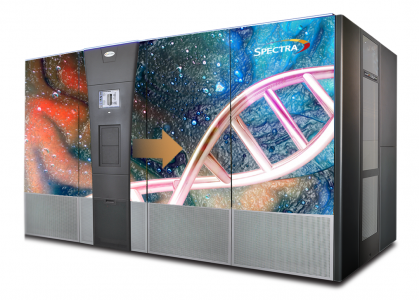
Spectra Logic tape libraries and BlackPearl object storage hold data for decades at low cost. Mediaflux gives that data a searchable catalogue and moves it between tiers by policy.
- Libraries from a single rack to exabyte scale
- Air-gapped copies for ransomware resilience
- Metadata-driven discovery and recall
06Engagement
Start with an assessment.
We measure what you hold and how it is used before we propose anything. The assessment report is yours whether or not you go ahead.
Assess
Volumes, growth, file types and access patterns.
Design
Tiers, policies, metadata and sizing.
Pilot
One project or department proves the workflow.
Migrate
Existing data moved in, verified file by file.
Deploy
Production rollout and training.
Operate
Monitoring, media management and support.
07Questions
Enterprise data, answered.
What is an active archive?
Is tape still relevant for AI data?
What does Arcitecta Mediaflux do?
How does this protect against ransomware?
08Data infrastructure enquiries
Request a data assessment.
Tell us roughly how much data you hold and what it is for. A storage architect replies within one working day.
- Sales
- sales@cinthamani.com
- India
- +91 44 2815 3842